Why fish oil quality looks better on labels
You’re scrolling a product page and the numbers seem reassuring: “1000 mg,” “triple strength,” “pharmaceutical grade.” Then you flip to the Supplement Facts and realize the label is doing a little sleight of hand. In most fish oil softgels, that big milligram number is the amount of oil in the capsule—not the amount of EPA and DHA you’re actually shopping for.
That’s why two bottles can look similar in the cart but behave very differently in real use. A “1000 mg fish oil” capsule might only provide a few hundred milligrams of combined EPA/DHA, while another product concentrates those fats so the same serving delivers more of what people associate with heart, brain, or joint support. The quality language can also sound definitive even when it’s mostly marketing shorthand, and the details that matter—how much EPA/DHA per serving, whether there’s any independent testing, and how recent the lot is—tend to be tucked into smaller print.
Even when the label is technically accurate, it can still overpromise the experience at home. Fish oil is sensitive to time, heat, and light, so “high potency” on day one doesn’t always feel like “high quality” months later. That gap between bold front-label claims and the quieter signals of dose and freshness is where most confusion starts.
Potency gaps between stated and measured omega-3s
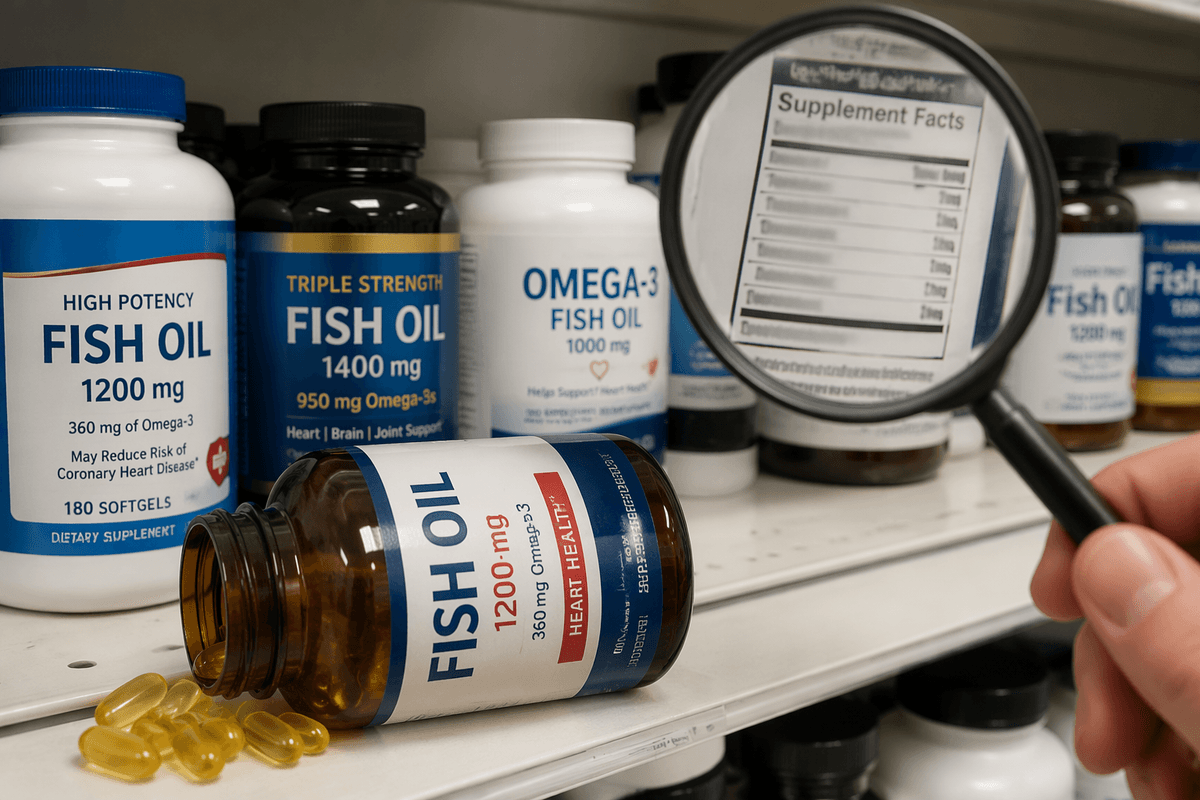
The first clue is usually how many capsules you need to hit the number you thought you were buying. You might add up the serving size and realize your “triple strength” is only strong if you take three softgels, or that the EPA and DHA are split across lines in a way that’s easy to skim past when you’re in a hurry.
Where it gets messier is when measured amounts don’t perfectly match the stated ones. Omega-3 concentrates are blended from batches of oil, and small shifts in processing or raw material can change the final EPA/DHA profile. Reputable brands build in a buffer and verify the finished lot, but that doesn’t mean every product on a shelf is hitting the exact milligrams printed on the label every time.
Consumer lab tests tend to focus on that exact issue: they measure EPA and DHA in the finished capsule and compare it to the claim. When results come back low, it doesn’t always scream “fake,” but it does make the real-world outcome less predictable—especially for people who are counting on a consistent daily dose rather than just “some fish oil.”
Oxidation and the ‘fishy burp’ misunderstanding
The first time it happens, it’s usually after a normal breakfast: a warm, unmistakably fishy burp that makes you wonder if the capsules “went bad” overnight. A lot of people treat that as the only freshness test, but burps are a messy signal. They can show up just because the softgel dissolves higher in the stomach, because you took it on an empty stomach, or because the coating isn’t doing what “burp-less” implied.
Oxidation is the slower, quieter issue. Omega-3 fats are reactive, and over time they can break down when they’re exposed to heat, light, and oxygen. That’s when the oil may start to smell sharper in the bottle, or the aftertaste lingers longer, even if the label and capsule count haven’t changed. Consumer labs often look at oxidation markers, but those tests don’t always match what you notice day to day—especially if one bottle sits in a hot car trunk once and another lives in a cool pantry.
So “fishy” can mean two different things: digestion and delivery…or oil that’s drifting from fresh toward stale. The annoying part is the overlap, which is why lot dates, storage habits, and a quick sniff check sometimes tell you more than the marketing on the front.
Contaminants: reassurance, caveats, and what varies

You notice it when you slow down on the label and your eyes land on a familiar line: “tested for mercury.” It’s reassuring, especially if you’re picturing big predator fish and heavy metals, but it can also read more complete than it is. Most mainstream fish oil is refined, and that processing tends to remove a lot of the stuff people worry about—so a clean test result isn’t rare, it’s closer to the baseline expectation for a well-made product.
The caveat is that “contaminants” isn’t one thing, and not every brand is proving the same list. Some reports focus on heavy metals, others add PCBs or dioxins, and some only say “meets limits” without showing numbers. That’s where variation creeps in: the source species, where it was harvested, how concentrated the oil is, and whether the finished lot was tested can all change what “purity” really means for that bottle.
In practice, third‑party seals and lot-specific certificates can reduce the guessing, but they don’t eliminate it. And if you’re already watching oxidation, it helps to remember that purity and freshness are separate problems—an oil can be low in residues and still drift toward stale over time.
Form and delivery differences that change real-world use
It often shows up as a small, annoying pattern: one bottle feels “easy,” and another—same labeled dose—keeps repeating on you with reflux, aftertaste, or a heavy feeling that makes you skip days. That’s where form and delivery start to matter more than the front-label strength. A softgel that dissolves quickly can bring the oil back up, while an enteric-style coating may push that release lower, changing whether you notice it at all.
More concentrated oils can mean fewer capsules, but they can be less forgiving if you’re sensitive to texture or smell, and any stale note is harder to miss. Some products swap to triglyceride, re‑esterified triglyceride, or ethyl ester forms; people don’t always feel a dramatic difference, but digestion and “repeat” aftertaste can vary, especially with meal timing.
So when “burp-less” doesn’t match your experience, it may not be a quality failure as much as a delivery mismatch—and that mismatch can quietly change how consistently you take the product.
The price-per-EPA/DHA reality check consumers miss
It’s the moment you drop a “cheap” bottle into your cart and notice the serving size is two softgels, not one. Suddenly the price looks different, because you’re not really buying “1000 mg” of oil—you’re buying a certain number of milligrams of EPA and DHA delivered consistently enough to matter.
This is where labels quietly distort value. A lower-priced product may be mostly carrier oil with modest EPA/DHA, so you need more capsules per day to reach the same target. Meanwhile, a higher-priced concentrate can look expensive per bottle but end up cheaper per usable omega‑3 once you do the math on EPA+DHA per serving and servings per container. The limitation is that the math assumes the capsule matches the label and stays fresh through the last week.
And the “deal” can flip again if you stop taking it because it repeats on you, smells sharp, or feels inconsistent. Cost per capsule is simple; cost per reliably tolerated EPA/DHA is the number most people don’t calculate.
What quality testing can’t fully capture yet
Halfway through a bottle, you might crack the lid and catch a faint “painty” note, then look at the third‑party seal and wonder how both can be true. Most consumer testing is a snapshot: the lab measures EPA/DHA and oxidation markers in that lot at that moment, usually under controlled handling. What it can’t fully reflect is what happens afterward—weeks of being opened daily, a few warm shipping days, or a brief stint in a sunny kitchen—small exposures that can speed the slow drift you actually notice.
Even “passes limits” has blind spots. Reports rarely capture capsule-to-capsule variation, how the oil behaves in your stomach, or whether the sensory experience pushes you to skip doses. And many certificates are hard to match to the exact bottle in your hand unless there’s a clear lot number and expiry you can trace.
So testing is useful, but it doesn’t replace the quieter clues: a consistent smell, a stable routine, and packaging details that make the product easier to verify over time.