The route matters more than the miles
At 8:10 a.m. in a Sarajevo rental-car lot, I watched a couple zoom the map out and say, “Most of these towns are only 150 kilometers apart.” Then the attendant pointed at the rain on the windshield and shrugged—“mountain roads”—and suddenly the numbers felt optimistic. In Bosnia, distance reads like a promise; the route is the fine print.
A “best of Bosnia” loop isn’t about maximizing pins, it’s about minimizing the wrong kind of driving: steep passes that slow a compact car, village speed limits that never show on glossy itineraries, and the half-hour you lose hunting a legal spot in a pretty center. A direct hop can look efficient and still cost more daylight than a longer scenic road that keeps you moving. This is why Una + Jajce + Sutjeska can work for an 8-day trip, but only if you accept a couple of longer, earlier-start days and avoid bouncing back through Sarajevo just because it’s familiar.
Plan your overnights like anchors—Sarajevo at the start, then a strong base in the Herzegovina south, and one in the northwest if you insist on Una. It suits couples who’d rather trade one ambitious drive for two unhurried town afternoons; if you hate narrow roads or get tense with tailgaters, you’ll want the smoother valleys and fewer “shortcut” ambitions. The goal is simple: arrive with enough energy left to walk the riverfront, not just photograph it from the car.
Route basics and driving realities
Just past Konjic, I hesitated at a hand-painted sign that promised a “shorter” turn toward the hills, while my phone insisted the main road was only five minutes longer. The asphalt up the side road looked freshly patched in stripes, and a bus stopped dead ahead to negotiate a bend. It was the moment Bosnia’s driving math clicked: the route that looks clever on the map can cost you the hour you thought you’d spend at a viewpoint.
For timing, assume your average speed will feel closer to “scenic” than “highway,” even when the road is technically good. A compact car is fine on the main corridors, but mountain sections add invisible drag: tight curves, trucks that set the pace, and village speed limits that arrive with a crosswalk and a café terrace. If you’re the couple that likes unhurried lunches and late museum starts, cap most days at 2.5–3.5 hours of driving; push to 5–6 only when the reward is a whole new region.
Parking is the other quiet time thief, especially in Sarajevo and Mostar where the prettiest blocks are the least forgiving. Plan for a trade-off: stay closer to old towns and pay (and sometimes squeeze), or sleep a 10–15 minute walk out and arrive calmer. It works best if one of you is willing to hop out and spot; if tight ramps and impatient horns raise your blood pressure, you’ll want accommodations with confirmed parking, even if the view from the window is less romantic.
A scenic 7-day Bosnia loop
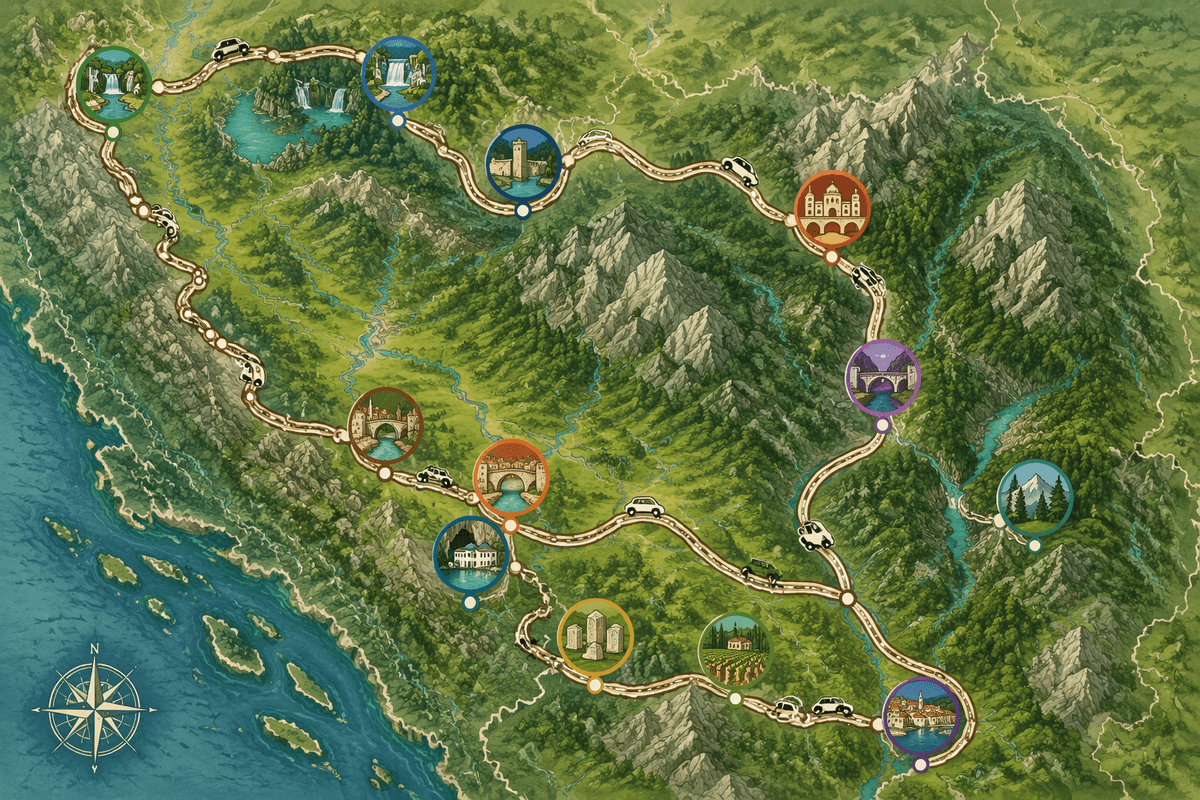
At 7:05 a.m. I stood by the Miljacka with two coffees and a folded road map, trying to decide whether to point the car south toward Mostar or northwest toward Jajce. The map made both look like tidy arcs; the traffic lights on the way out of Sarajevo made them feel like commitments. With an 8-day rental, I’d rather spend the first real day arriving somewhere beautiful than proving I can “cover” Bosnia.
Here’s the loop that stays scenic without pretending Bosnia is flat: Day 1 Sarajevo → Konjic → Mostar (about 2.5–3.5 hrs with a riverside stop); overnight Mostar 2 nights so you can walk the Old Bridge at dusk without hunting parking twice. Day 2 is low-driving: Blagaj + Počitelj (short hops, heat-dependent—midday gets sluggish). Day 3 Mostar → Trebinje via Stolac/Radimlja (3–4.5 hrs depending on detours), a smoother trade than forcing a long mountain day when you’re already tired.
Day 4 Trebinje → Sutjeska/Tjentište → Foča (4–6 hrs; works if you start early and accept that the park is the point, not a quick photo). Day 5 Foča → Jajce (4–5.5 hrs; slower but town-walk-friendly), then Day 6 Jajce → Bihać/Una (3.5–5 hrs—worth it for couples who’ll actually hike to viewpoints). Day 7 Bihać → Sarajevo (5.5–7 hrs): the least romantic drive, but it buys you a calm final night near the airport instead of a last-minute sprint.
Stays, food stops, and parking wins
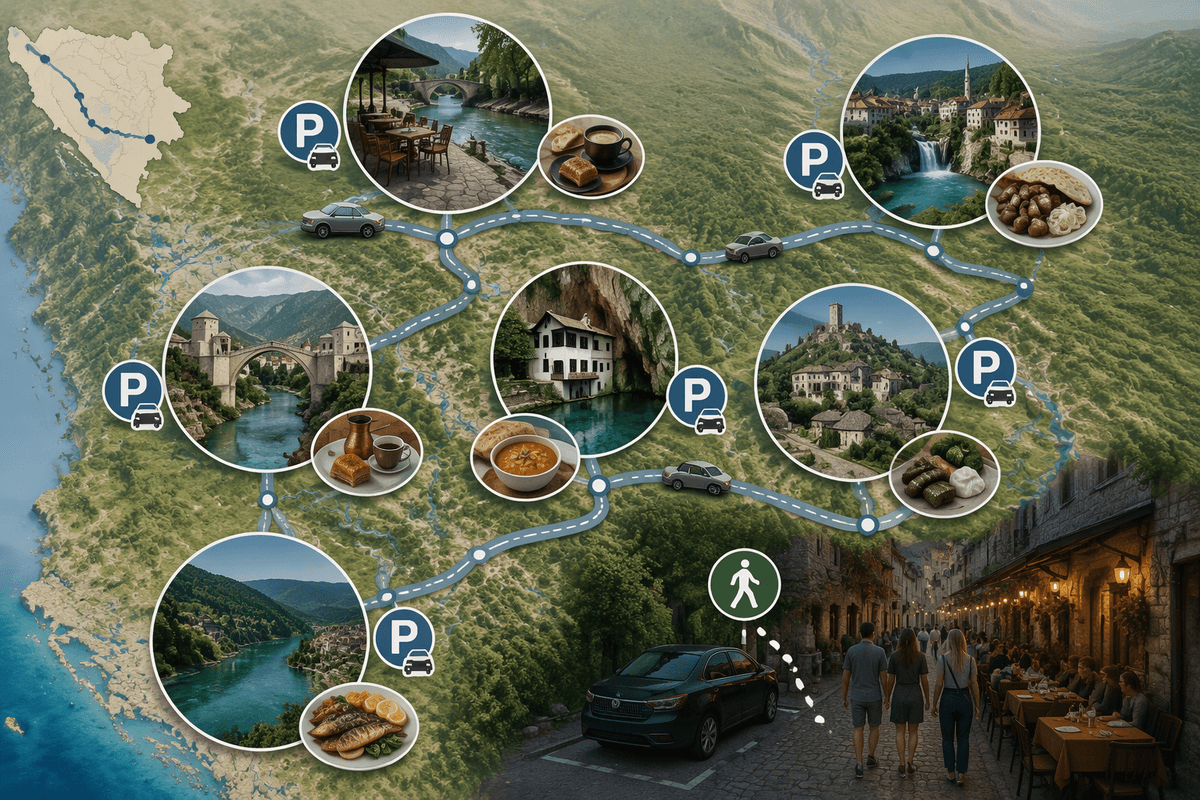
At 6:45 p.m. in Mostar, I watched a compact hatchback try to reverse out of a one-car-wide “hotel parking” ramp while three scooters threaded past, unbothered. We’d chosen a place “inside the old town,” which sounded romantic until the alley turned into a negotiation. Five minutes later we were parked—technically—and suddenly the extra 12 BAM felt like the cheapest part of the night.
For stays, I’d bias toward bases that reduce repeat parking stress rather than chase the prettiest address. In Mostar, that usually means a small hotel/guesthouse just outside the pedestrian core: close enough for a dusk Old Bridge walk, far enough that you can arrive without performing a three-point turn for an audience. Trebinje is the opposite trade-off—staying near the river promenade is easy and calm, and it suits couples who want a late dinner stroll without planning logistics. In Sarajevo (first or last night), pick somewhere with confirmed, written parking instructions; “public parking nearby” can mean circling steep streets after dark when you’re already tired.
Food stops are easiest when they’re attached to your natural slow points. Konjic works for a riverside coffee break because you’re stopping anyway, and it keeps Day 1 from feeling like a single push to Mostar; just don’t aim for a long lunch if you still want daylight in Mostar’s lanes. On the Blagaj/Počitelj day, eat early or late—midday heat plus tour-bus timing makes even a simple meal feel like a queue. In Jajce and Bihać, the win is choosing dinner within walking distance of your overnight so the car stays parked; after a 4–6 hour day, the “best restaurant across town” is rarely worth the second round of parking.
Parking habits are where Bosnia rewards humility. Old-town centers (Mostar, Sarajevo) work best with one person hopping out to spot and a willingness to take the first legal space, even if it adds a 10–15 minute walk. Una/Jajce are kinder, but weekends compress everything—arrive earlier than you think, especially if you want viewpoints without crowd flow pushing you along. If you’re deciding between a slightly nicer room and guaranteed parking, I’d take the parking and spend the saved nerves on a longer evening walk.
If you have fewer days, do this
At 8:55 a.m. on a checkout morning in Trebinje, I watched the clock eat the “quick” coffee we’d promised ourselves, then watched the GPS add five minutes every time I moved the map. With fewer days, that creeping delay matters more than the headline drive time, because Bosnia’s slow bits don’t announce themselves until you’re already committed to the bend.
If you have 4–5 full days, skip the northwest and build a south-and-center loop that stays rewarding without heroic starts: Sarajevo → Konjic → Mostar (2.5–3.5 hrs); one low-driving day for Blagaj + Počitelj (heat and tour-bus timing decide whether you linger); Mostar → Trebinje via Stolac/Radimlja (3–4.5 hrs); Trebinje → Sarajevo via the faster corridors (roughly 4.5–6 hrs). It works best for couples who want Ottoman towns and river scenery, and it avoids the trade-off of arriving everywhere tired and parking twice.
If you have 6 days and want one “wild landscape” day, keep Sutjeska but drop Una: Mostar → Trebinje → Sutjeska/Tjentište → Foča → Sarajevo, then give Sarajevo a final buffer night so your return isn’t a dusk sprint through city traffic. The decision cue I’d use is simple: if either of you gets tense on narrow, shoulderless stretches, spend that day walking Mostar’s lanes instead—you’ll remember the evening light longer than the extra pin on the map.